Have Elections Lost Their Power in Nepal, or Has Political Leadership Lost the Public’s Trust?
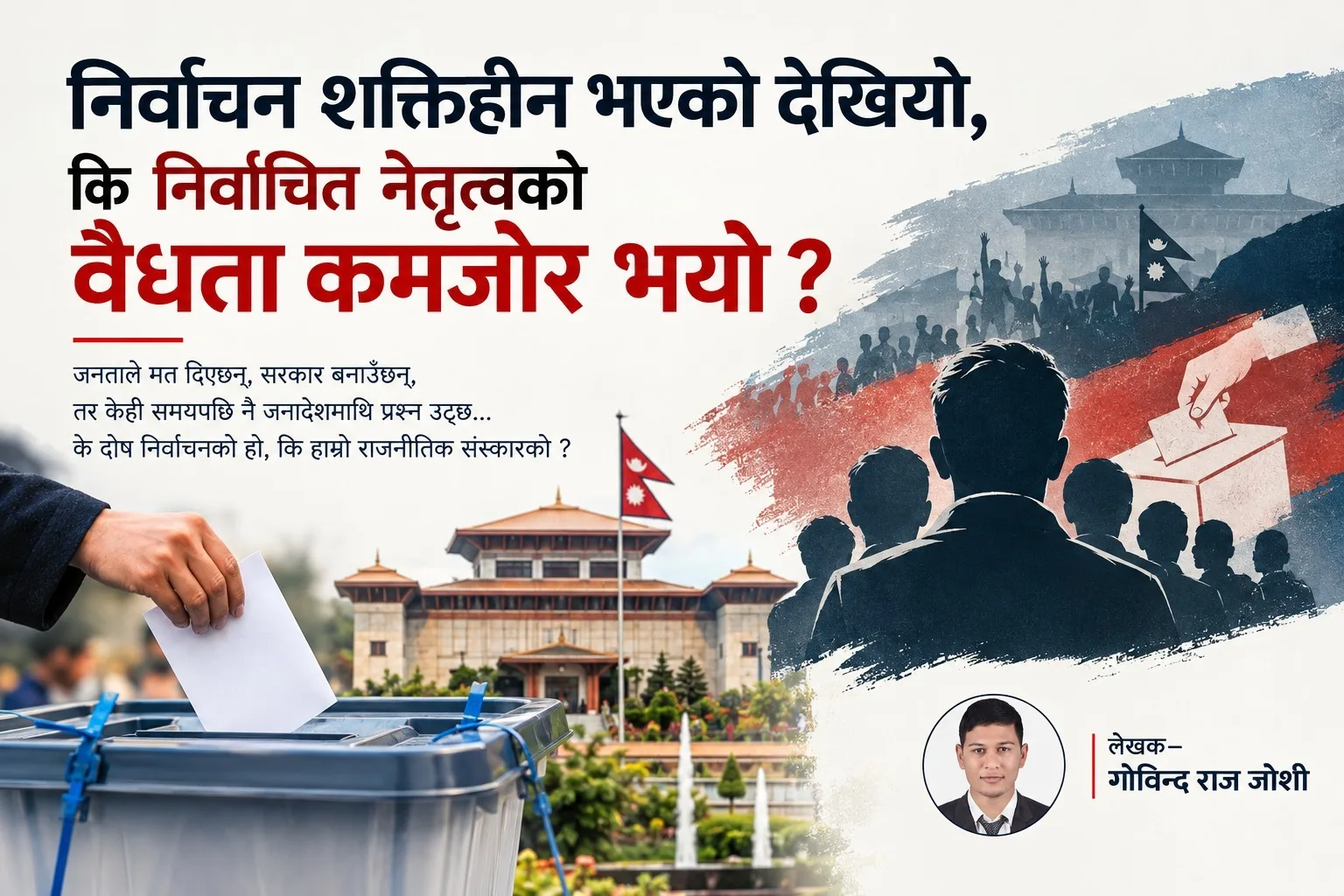
Elections are one of the most important foundations of democracy. People choose their representatives, elected leaders form the government, and the government is expected to serve the public. After a fixed term, voters get another opportunity to decide whether those leaders deserve to remain in power.
This process gives a government its democratic legitimacy. But recent political developments in Nepal have raised an important question: Are elections losing their power, or are political leaders failing to respect the mandate they receive from voters?
The distinction matters. Elections may give politicians the authority to govern, but maintaining public trust requires more than winning votes. Nepal’s recent political changes have brought this issue into sharper focus, raising questions about leadership, accountability and the strength of democratic institutions.
When an Elected Government Cannot Complete Its Term
The protests of Bhadra 23 and 24, 2082, marked a significant turning point in Nepal’s political landscape. Growing public dissatisfaction, particularly among young people, challenged the established political leadership and ultimately led to the departure of the government that had received its mandate through elections.
The country subsequently moved toward another election in Falgun 2082 under an interim political arrangement.
The important question is not simply whether the protests were justified. It is why a government elected to serve a fixed term could lose its position before completing that term.
Public protests are a legitimate part of democracy. Citizens must have the freedom to express dissatisfaction when they believe their leaders have failed them. At the same time, elections provide an institutional mechanism through which people can choose their representatives and hold them accountable.
Both the ballot box and the streets can express public opinion. The challenge arises when political institutions fail to connect these two forms of democratic expression.
If citizens feel that their elected representatives no longer listen to them, dissatisfaction can grow beyond what ordinary political processes can accommodate. In such circumstances, the problem extends beyond an individual government. It raises questions about how effectively democratic institutions respond to changing public expectations.
Nepali Congress: Why Did Leadership Change Become Necessary?
The leadership changes within the Nepali Congress have brought similar questions into the discussion.
The party’s special general convention in Poush 2082, which resulted in a new central leadership under Gagan Thapa, demonstrated that leadership can change through internal party processes.
There is nothing inherently undemocratic about replacing existing leaders. Political parties must be able to reconsider their direction, respond to members’ concerns and introduce new leadership when necessary.
However, the circumstances that make such changes necessary deserve attention.
Why did the party reach a point where a special convention became the means of changing its leadership? Had the existing leadership failed to respond adequately to the concerns of party members and the wider public? Or had the political environment changed faster than the party’s internal decision-making process?
These questions are more significant than the leadership change itself.
A political party cannot remain relevant simply because it has a long history or an established voter base. It must continually demonstrate that its leadership understands public concerns and can adapt to changing political realities.
When ordinary internal processes struggle to address dissatisfaction, the party must examine the reasons behind that failure.
The Leadership Debate Within UML
The debate over leadership within the CPN-UML has also brought internal democracy into focus, particularly in discussions surrounding KP Sharma Oli and demands for leadership restructuring and generational change.
Following electoral setbacks, questions have emerged about responsibility, the party’s future direction and the role of its senior leadership. An internal survey has reportedly shown substantial support for leadership restructuring, with 87.6 percent of participants favouring change.
Such a figure, if representative of the survey’s participants, indicates considerable dissatisfaction within that particular group. However, its wider significance depends on the survey’s methodology, the number of participants and how they were selected.
The broader issue remains relevant regardless of the survey.
When party members begin demanding leadership changes before the next regular leadership election, it raises questions about whether existing party mechanisms provide sufficient opportunities for accountability and renewal.
Senior leaders may have considerable political experience and organisational influence. Yet experience alone cannot guarantee continued support from party members or voters.
At the same time, leadership changes should follow established party rules rather than depend entirely on internal pressure or individual rivalries. A healthy party needs clear procedures through which members can challenge existing leadership, debate alternative approaches and choose new representatives.
Without such mechanisms, calls for reform can become another source of prolonged internal conflict.
Leadership Questions in Prachanda’s Party
The party led by Pushpa Kamal Dahal, widely known as Prachanda, has also faced discussions about leadership restructuring, generational change and its future direction following disappointing electoral results.
The suggestion that senior leaders should take on a more advisory or parental role reflects a wider debate about how political parties manage the transition between generations.
Experienced leaders can provide valuable guidance, institutional knowledge and political stability. However, these contributions do not necessarily require them to retain the highest positions indefinitely.
Younger leaders, meanwhile, need more than symbolic opportunities. They require meaningful responsibilities, the freedom to develop their own political ideas and a fair chance to demonstrate their abilities.
Generational change should therefore be more than a slogan used after electoral defeat. It should be part of a transparent and consistent process of leadership development.
The same questions are emerging across Nepal’s political landscape: Can established parties renew themselves from within? Can they create space for new leadership without descending into prolonged internal disputes? And can they reconnect with voters whose expectations have changed?
These challenges are not identical across parties, but they point toward a common concern about political representation.
The Electoral Setback of Madhesh-Centred Parties
The performance of Madhesh-centred parties in the Falgun 2082 House of Representatives election provides another important dimension to this debate.
According to the reported results, no Madhesh-centred party won a directly elected seat. For political organisations that have played an important role in representing Madhesh-related concerns, this outcome raises serious questions about their future.
Their electoral difficulties should not be dismissed as a temporary loss of seats. They may indicate that many voters are reconsidering whether these parties adequately represent their interests.
However, an electoral defeat does not automatically mean that every aspect of a party’s political agenda has been rejected. Voters may be responding to leadership decisions, organisational weaknesses, candidate selection, governance records or the availability of alternative political forces.
Understanding the reasons requires more than looking at the final seat count.
Parties that once enjoyed strong regional support must examine whether their organisational structures and political messages still reflect the concerns of their constituencies.
The central question is whether they will treat the results as a temporary setback or use them as an opportunity to reconsider their leadership, priorities and relationship with voters.
Their future will depend partly on how seriously they undertake that assessment.
If Elections Are Weakening, Why Are Voters Still Changing Governments?
There is an important contradiction in the argument that elections have lost their power.
If elections no longer mattered, how could the 2082 election produce such a dramatic shift in parliamentary representation, including a reported 182 seats for a new political force?
The result suggests that elections remain a powerful instrument for political change. Voters can reject established parties, support unfamiliar alternatives and reshape the balance of power in Parliament.
In other words, the ballot box continues to matter.
The deeper concern is whether the authority gained through elections is being matched by responsible leadership after the results are declared.
People vote, governments change, and new leaders take office. Yet dissatisfaction can return when elected representatives fail to meet public expectations. The cycle then begins again, with questions about leadership, accountability and political credibility.
This raises a more fundamental issue: Is the problem with elections themselves, or with the political culture that develops between elections?
An election can determine who receives the authority to govern. It cannot, by itself, guarantee that those who win will use that authority wisely.
Nor can a single election resolve every institutional weakness within a political party. For democracy to remain effective, the period between elections matters just as much as election day.
Voters May Be Disappointed With Leaders, Not Elections
Before concluding that public confidence in elections is declining, it is worth distinguishing between dissatisfaction with the electoral process and dissatisfaction with the people elected through it.
These are not the same thing.
When voters replace established political parties with new alternatives, they are still using elections to express their preferences. Their decisions may reflect frustration, changing priorities or a desire for a different approach to governance.
The pattern is straightforward:
When voters are dissatisfied with existing leadership, they can choose different candidates.
When a party fails to deliver, voters can support its opponents.
When established political options lose credibility, voters can consider alternatives.
When political priorities change, electoral preferences can change with them.
This is not necessarily evidence that democracy has failed. It can also demonstrate that voters are willing to exercise their democratic rights to demand change.
In this sense, elections function not only as a means of choosing representatives but also as a way of rewarding performance and penalising failure.
The challenge for political parties is to understand what these choices communicate rather than dismiss unfavourable results or assume that previous support will automatically return.
Are Political Parties Democratic Within Their Own Organisations?
One of the most important questions concerns the gap between the democratic principles political parties promote publicly and the practices they follow internally.
Political parties frequently speak about accountability, representation and public participation. But how consistently do they apply these principles when selecting leaders, distributing responsibilities, encouraging criticism and making important decisions?
When decision-making becomes concentrated around a small group of individuals, party organisations can gradually lose their role as spaces for debate and the development of ideas.
Members may find it difficult to challenge senior leaders. Emerging politicians may struggle to gain meaningful responsibilities. Important decisions may depend more on personal relationships than on transparent procedures.
Such problems can weaken a party even when it continues to participate in elections.
Internal democracy requires more than holding a general convention at regular intervals. It also depends on whether members can express disagreement without being marginalised, whether leadership positions are genuinely contestable and whether party rules apply consistently to everyone.
Without these safeguards, leadership renewal may occur only when a party faces an extraordinary crisis.
That is why the issue extends beyond deciding which individual should step aside. The more important question is whether the political system within each party can consistently produce capable leaders and hold them accountable.
Winning an Election Is Not a Blank Cheque
Another problem arises when political leaders treat electoral victory as unlimited permission to govern without meaningful accountability.
Winning an election gives a party the authority to implement its programme within constitutional and legal limits. It does not give its leaders unrestricted control over public institutions or remove their responsibility to listen to citizens.
An electoral mandate is a responsibility, not a blank cheque.
The same principle applies to electoral defeat. Losing an election does not mean that a political party has no future or that its members should abandon public life. It means that the party must understand why voters chose another option and determine what needs to change.
Yet political debate can sometimes follow a different pattern. Victorious parties may interpret their success as proof that their decisions are beyond criticism, while defeated parties may blame external factors rather than examine their own weaknesses.
Both responses can prevent meaningful reform.
Respecting democracy requires leaders to accept scrutiny when they win and acknowledge the results when they lose. It also requires political parties to recognise that public support must be earned repeatedly rather than assumed indefinitely.
Political Legitimacy Must Be Maintained Between Elections
An election can establish a government’s legal and democratic authority, but maintaining public confidence is an ongoing responsibility.
Citizens judge political leadership through the decisions it makes, the promises it fulfils, the way it responds to criticism and the seriousness with which it addresses public concerns.
A government may win a convincing majority and still face questions about its performance. A party may lose an election and subsequently rebuild public confidence through organisational reform and credible leadership.
Political legitimacy, therefore, cannot be understood solely through the number of seats won or the votes received.
It also depends on whether people continue to believe that their representatives are listening to them and acting within the responsibilities entrusted to them.
This does not mean governments should change whenever public opinion shifts or every protest should determine who holds office. Democratic institutions need stability, established procedures and respect for constitutional rules.
However, stability should not become an excuse for ignoring dissatisfaction. Institutions must provide credible ways for citizens and party members to raise concerns, challenge decisions and seek accountability.
The goal is not constant leadership change. It is a political system capable of responding to problems before they develop into crises.
Nepal’s Political Parties Face a Test of Renewal
The leadership transition in the Nepali Congress, the restructuring debate within UML, the discussion of generational change in Prachanda’s party and the electoral difficulties of Madhesh-centred parties are different developments. Each has its own history and circumstances.
Nevertheless, they raise a shared question about how Nepal’s political parties respond when their existing leadership or organisational approach loses support.
The answer cannot simply be to replace one leader with another. New faces may bring fresh ideas, but leadership change alone does not guarantee better governance.
Meaningful renewal requires stronger internal democracy, transparent decision-making, clearer accountability and genuine opportunities for capable people to contribute.
It also requires political parties to take public dissatisfaction seriously before it becomes an electoral disaster.
Nepali voters are not merely choosing who should govern. Through their electoral decisions, they are also signalling what they expect from political leadership and how much confidence they place in established institutions.
Parties that recognise these signals have an opportunity to rebuild their credibility. Those that ignore them may find it increasingly difficult to regain public support.
The Real Question Is What Happens After the Ballot
Have elections lost their power in Nepal?
The recent political developments do not, by themselves, establish that conclusion. If anything, major electoral shifts demonstrate that voters can still influence the direction of the country through the ballot box.
The more pressing question is why the authority gained through elections can become politically fragile when leaders fail to maintain public confidence.
Elections determine who receives the mandate to govern. Democratic institutions determine how that mandate is exercised, challenged and held accountable.
If political parties cannot respond to changing public expectations through their regular internal processes, pressure for change may emerge through protests, factional disputes or electoral rejection.
If they fail to learn from those experiences, the same problems may return under different leaders and party names.
Nepal’s political future will depend not only on who wins the next election but also on whether political parties can build institutions that deserve public trust between elections.
The ballot box can transfer power. Sustained public confidence gives political leadership the credibility to exercise that power responsibly.
Ultimately, the strength of democracy is measured not only by whether elections take place, but also by whether elected leaders remain accountable to the people whose votes brought them to power.