Nepal’s IT Exports Approach $1 Billion: Can the Digital Economy Become a Major Driver of Growth?
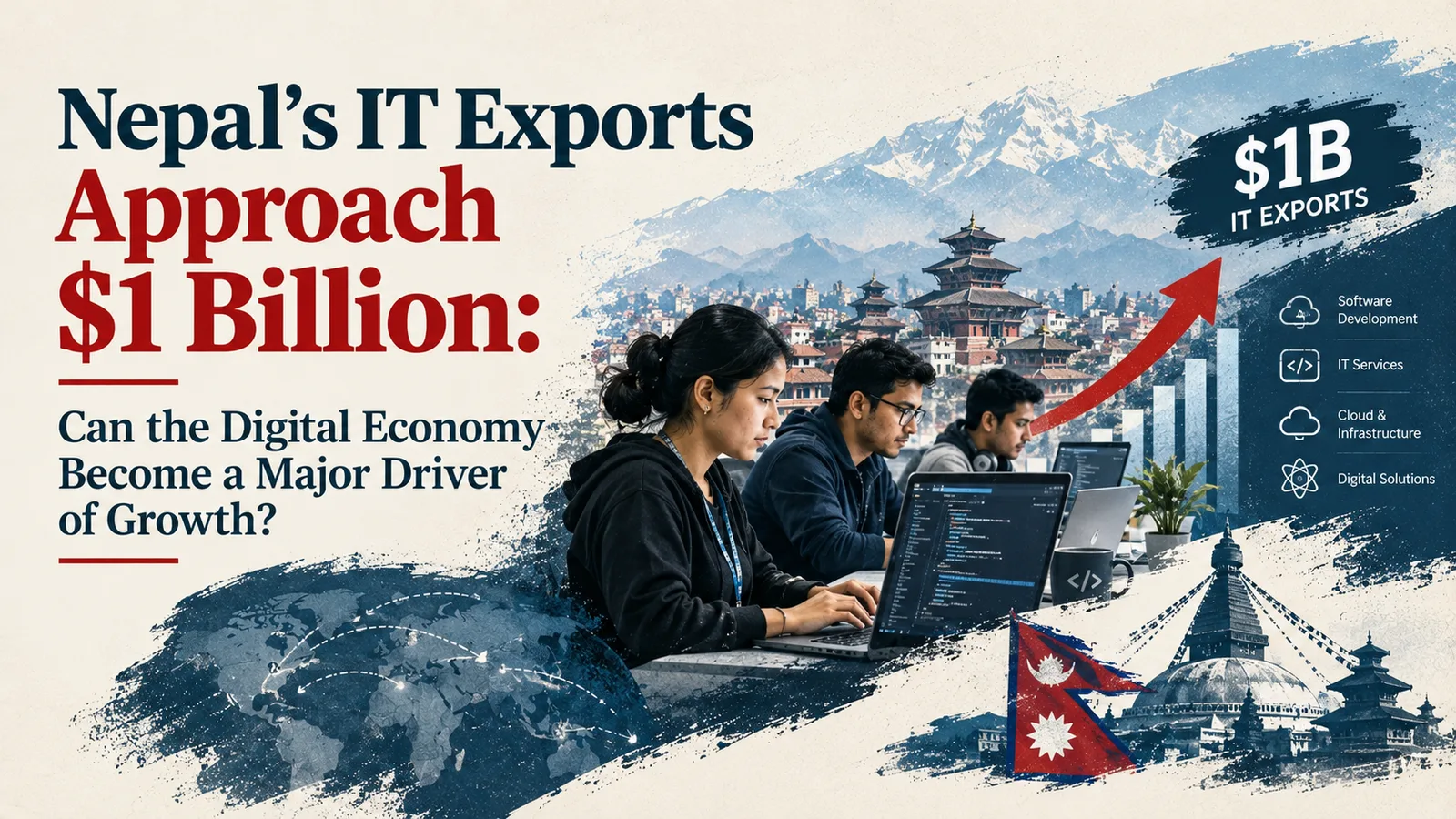
Nepal's technology industry is entering a period of growing economic importance. Software developers, IT companies, freelancers and business process outsourcing firms are providing services to customers around the world, creating an export business that does not depend on transporting physical goods across international borders.
In February 2026, representatives of the Nepal Association for Software and IT Services Companies (NAS-IT) estimated that Nepal's annual IT service exports had reached approximately US$1 billion in 2025, equivalent to around Rs 145 billion. The estimate marked a substantial increase from the US$515.4 million recorded in a 2022 study by the Institute for Integrated Development Studies (IIDS).
However, there is an important distinction behind these figures. The US$1 billion estimate is based on industry assessments rather than a recent, comprehensive nationwide survey. Official statistics report a considerably smaller figure for the narrower category of telecommunications, computer and information services. Understanding this difference is essential to assessing the industry's actual contribution to Nepal's economy.
The question now is whether Nepal can turn its growing digital services business into a reliable source of foreign earnings, skilled employment and long-term economic development.
Nepal's IT Export Industry Has Changed Significantly
For years, Nepal's international economic profile has been closely associated with tourism, remittances, hydropower and traditional exports. Technology services offer another way for Nepali businesses to earn money from overseas markets.
A software company in Kathmandu can develop an application for an Australian business. A designer in Pokhara can create a digital product for a client in Europe. A team working in Nepal can process business data, maintain software or provide technical support to an international organisation.
These activities demonstrate how digital services allow businesses to reach customers far beyond Nepal's domestic market.
The IIDS study, Unleashing IT: Advancing Nepal's Digital Economy, estimated that IT service exports reached US$515.4 million in 2022. The study also identified thousands of freelancers and technology-enabled service workers participating in international markets.
By February 2026, NAS-IT was estimating annual exports at around US$1 billion for 2025. The association attributed the increase to the expansion of technology businesses and other digitally delivered services.
The newer estimate is encouraging, but it should be interpreted carefully. Without a comparable nationwide study, it is not possible to establish the exact annual growth rate with the same confidence as a consistently measured official series.
Nevertheless, the available evidence indicates that technology services have become an important part of Nepal's economic conversation.
Why IT Exports Matter to Nepal
Exports bring income into an economy by connecting domestic producers and service providers with international customers. For Nepal, which purchases many goods and services from abroad, earning foreign currency is particularly important.
Traditional exports often involve manufacturing, agricultural production, transport and other physical processes. IT exports rely more heavily on skilled workers, computers, internet connectivity and the ability to deliver services remotely.
This does not make technology exports effortless. Companies still need to pay salaries, maintain systems, acquire customers and meet international standards. However, the ability to serve overseas markets without establishing a physical presence in every destination gives the industry a different set of growth opportunities.
A new source of foreign earnings
When a Nepali company receives payment from an overseas client for software development or another eligible service, that transaction can contribute to the country's service export earnings.
The economic impact extends beyond the company itself. Businesses may use their revenue to pay employees, rent offices, purchase equipment, hire local suppliers and invest in new products.
Employees may spend their income on housing, education, transportation and other services. This creates economic activity beyond the original export transaction.
The scale of these wider effects depends on how much revenue remains in Nepal, how businesses invest their earnings and how many local jobs they create.
A stronger IT export sector could therefore help diversify Nepal's sources of foreign income rather than relying as heavily on a limited number of traditional industries.
Why Official IT Export Figures Are Much Lower
One of the most important questions surrounding Nepal's technology industry is why the industry's estimated export earnings differ so significantly from official statistics.
According to reporting published by The Kathmandu Post on July 20, 2026, Nepal recorded Rs 22.33 billion in exports under the telecommunications, computer and information services category during fiscal year 2024/25. This represented 9.36% of total service exports for that period.
That figure is not directly comparable with NAS-IT's estimate of approximately US$1 billion in annual IT service exports. The figures cover different reporting periods and may use different definitions and methods of measurement.
Industry representatives have argued that some payments received by freelancers and technology businesses are recorded under other categories, including remittances, rather than being identified as service export earnings.
International payment arrangements can complicate the picture further. Some professionals receive money through overseas platforms or business entities, making it difficult to determine how much revenue should be attributed to Nepal's IT exports.
The absence of a comprehensive and regularly updated measurement system creates a problem for policymakers, investors and businesses.
Without reliable data, it becomes harder to determine the industry's exact size, measure its growth, identify its largest markets and evaluate whether government policies are producing the intended results.
A more consistent reporting framework would help Nepal recognise legitimate export earnings while giving businesses greater clarity about their financial obligations.
Which IT Services Are Driving International Demand?
Nepal's digital services industry includes a range of activities, from relatively small freelance assignments to specialised services delivered by established companies.
Software development and engineering
Software development allows Nepali professionals to build websites, mobile applications, business systems and custom platforms for international clients. Companies may provide complete development teams or focus on particular stages, such as testing, maintenance and technical support.
Business process outsourcing
Some international businesses outsource data processing, administrative operations and specialised support services to teams in Nepal. These activities can generate employment beyond conventional software engineering roles.
Artificial intelligence and data services
AI-related work, data analytics and technology-enabled business services offer additional opportunities. Businesses may help clients prepare data, maintain digital systems or develop software that incorporates AI capabilities.
However, demand for AI services also changes the skills companies require. Routine work may become easier to automate, increasing the importance of critical thinking, domain knowledge, data quality and technical expertise.
Freelancing and independent digital work
Freelancers can provide programming, web design, graphic design, testing and other digital services directly to international clients. Independent work can lower the barrier to entering global markets, although finding reliable customers and maintaining consistent income can be difficult.
These categories overlap, and their individual contributions to national export earnings are not yet fully established through a single comprehensive dataset.
Can Nepal Create More Skilled Jobs Through IT?
One of the industry's biggest attractions is its potential to create skilled employment without requiring every worker to leave the country.
NAS-IT representatives estimated in February 2026 that approximately 100,000 people worked in Nepal's IT sector. This was an industry estimate rather than an official employment census, so it should not be treated as a precise count.
Even so, the industry has the potential to support a diverse workforce. Software developers are only one part of the picture. Businesses also need designers, project managers, software testers, cybersecurity specialists, data analysts, customer support professionals and people who can communicate effectively with international clients.
For students and recent graduates, this creates opportunities to connect formal education with practical experience.
Employers, however, need more than certificates. They look for people who can solve problems, work with others, explain technical decisions and deliver dependable results. Building these skills requires time, practice and exposure to real projects.
Educational institutions can contribute by strengthening practical coursework, supporting internships and helping students work on projects that reflect real business needs.
Companies can also invest in training rather than relying exclusively on experienced candidates from an already competitive labour market.
The wider objective should be to develop a workforce that can adapt to changing technologies instead of depending on a narrow set of tools or temporary market trends.
The Opportunity for Nepali Technology Startups
Export-oriented services can provide an entry point for young businesses. A small team might initially develop websites, build business applications or maintain software for overseas customers.
Over time, experience gained through client projects can help that team identify recurring problems that might be addressed through its own products.
For example, a Nepali startup could develop school management software, an accounting platform for small businesses, a cybersecurity solution or a specialised application for a particular industry.
The distinction between services and products matters. A service company typically earns revenue by completing work for clients. A software product company develops a solution that can be sold or licensed to multiple customers.
Both models can succeed, but product businesses face different risks. They may need to invest substantially in development before earning revenue, and they must compete on usability, reliability, pricing and customer support.
There is no guarantee that every startup will find a viable market. Nevertheless, businesses that combine practical experience with a clear understanding of customer needs may be better positioned to develop products for both domestic and international users.
A stronger startup ecosystem could help Nepal move beyond providing services for other companies and toward building more technology products of its own.
The Challenges Nepal Must Address
The industry's growth does not eliminate the obstacles facing businesses that operate from Nepal. Several issues could limit its long-term competitiveness if they remain unresolved.
Internet connectivity and infrastructure
Technology businesses depend on reliable internet access, electricity and suitable working environments. Disruptions can affect delivery schedules, communication and customer confidence.
Improving infrastructure beyond the Kathmandu Valley would also help distribute opportunities across more regions.
Education and practical skills
Technology changes rapidly, and educational programmes must keep pace with the skills businesses need. Strong fundamentals remain essential, but students also benefit from practical work, communication skills and experience using modern development tools responsibly.
The goal should be to prepare graduates to learn and adapt throughout their careers.
Predictable policies and taxation
Businesses operating internationally need clear guidance on taxation, foreign currency, registration and compliance. Frequent uncertainty can make financial planning difficult and discourage investment.
A transparent, stable regulatory environment would help both domestic businesses and potential international partners make longer-term decisions.
Access to international payments
Receiving overseas payments efficiently is essential for freelancers and export-oriented companies. Clear procedures for legitimate cross-border transactions can reduce administrative difficulties and improve the accuracy of export statistics.
Competition and quality
Nepali businesses compete with providers from countries that have larger technology ecosystems and more established international networks.
Lower costs alone are unlikely to provide a lasting advantage. Companies also need to build reputations for quality, reliability, specialised knowledge and responsible data handling.
Cybersecurity and privacy are particularly important when international clients entrust sensitive business information to an external provider.
What Could Help Nepal Sustain IT Export Growth?
A lasting expansion of IT exports requires more than ambitious revenue targets. It depends on whether businesses can find customers, hire capable employees and operate within a predictable business environment.
First, Nepal needs better data on digitally delivered services. Regular surveys and clearer coordination between industry organisations, businesses and public institutions would make it easier to assess the sector's contribution.
Second, practical education and professional development need continued attention. Students should have opportunities to develop real projects, learn from experienced practitioners and build the communication skills needed to work with international customers.
Third, payment and regulatory processes should be clear enough for legitimate exporters to operate without unnecessary uncertainty. Better reporting would also help distinguish service exports from other financial transfers.
Finally, technology companies need to focus on sustainable business practices. Long-term customer relationships, sound financial management, reliable delivery and investment in employees are more valuable than chasing growth figures alone.
These changes would not guarantee success, but they could create stronger foundations for businesses seeking to expand into international markets.
What the Latest Figures Actually Tell Us
Nepal's IT export story is promising, but it needs to be understood through two separate sets of evidence.
The IIDS study estimated IT service exports at US$515.4 million in 2022. In February 2026, NAS-IT representatives estimated that annual exports had reached approximately US$1 billion in 2025.
At the same time, official statistics reported Rs 22.33 billion in telecommunications, computer and information services exports for fiscal year 2024/25.
These figures describe different measurements and should not be combined into a single continuous growth series. The industry estimate points to a potentially much larger export sector, while the official figure highlights the need to improve how digital earnings are identified and recorded.
For readers, businesses and policymakers, this distinction is important. Strong economic reporting should recognise promising developments without presenting estimates as independently verified facts.
The Road Ahead for Nepal's Digital Economy
Nepal's IT industry has an opportunity to become a more significant part of the country's economic future. Its ability to serve international customers remotely creates possibilities for export earnings, skilled employment and entrepreneurship.
But the next stage will depend on execution. Reliable infrastructure, relevant education, predictable policies, accessible international payments and stronger business capabilities will all influence whether the industry can sustain its momentum.
Nepal does not need to abandon traditional industries to benefit from technology. Instead, a more diversified economy could combine tourism, energy, agriculture, manufacturing and digital services in ways that create additional opportunities for businesses and workers.
The immediate priority is to understand the industry's true scale and build the conditions that allow it to grow responsibly.
The estimate that Nepal's IT service exports approached US$1 billion in 2025 is an important signal of the sector's potential. Turning that estimate into a measurable, sustainable economic achievement will require reliable data, long-term investment and continued improvements in the way Nepal develops and supports its digital workforce.
Frequently Asked Questions
How much does Nepal earn from IT exports?
NAS-IT representatives estimated that Nepal's annual IT service exports reached approximately US$1 billion in 2025. This is an industry estimate, not a confirmed official nationwide total.
What are Nepal's official IT export figures?
Nepal recorded Rs 22.33 billion in telecommunications, computer and information services exports in fiscal year 2024/25, according to reporting on official trade statistics. This category is narrower than the broader industry estimate.
Why are official figures different from industry estimates?
Differences in definitions, reporting periods and payment classifications may explain part of the gap. Industry representatives have said that some IT-related earnings are recorded as remittances or are not fully captured in official service export statistics.
Which IT services does Nepal export?
They include software development, web and mobile application development, IT outsourcing, data processing, AI-related services and other digitally delivered business services.
Can IT exports create jobs in Nepal?
Yes. Export-oriented technology companies can employ developers, designers, testers, analysts, support staff and other professionals. The number of jobs created depends on business growth and international demand.
What could help Nepal grow its IT export industry?
More reliable export data, practical technology education, dependable internet access, clear regulations, efficient international payment arrangements and stronger investment in business capabilities could support sustainable growth.
Sources and further reading
The following sources provide the factual basis for the figures and policy discussion in this article.
The Kathmandu Post: Foreign study costs outpace growth in Nepal’s service exports. Covers official service-export figures and the challenges of measuring IT earnings.
The Kathmandu Post: Nepal’s IT exports near $1 billion. Can the momentum be sustained?. Discusses the industry estimate, employment, AI services and policy challenges.
Fiscal Nepal: Nepal’s IT service exports reach estimated Rs 145 billion annually. Reports the NAS-IT estimate and industry perspectives.
Institute for Integrated Development Studies: Unleashing IT: Advancing Nepal’s Digital Economy (PDF)
Provides the research background for the 2022 export estimate.
Nepal Rastra Bank: Official website and macroeconomic reports. A primary source for Nepal's official economic and external-sector statistics.