Tesla Roadster & SpaceX Technology: The Flying Car Demonstration That Could Change Electric Cars
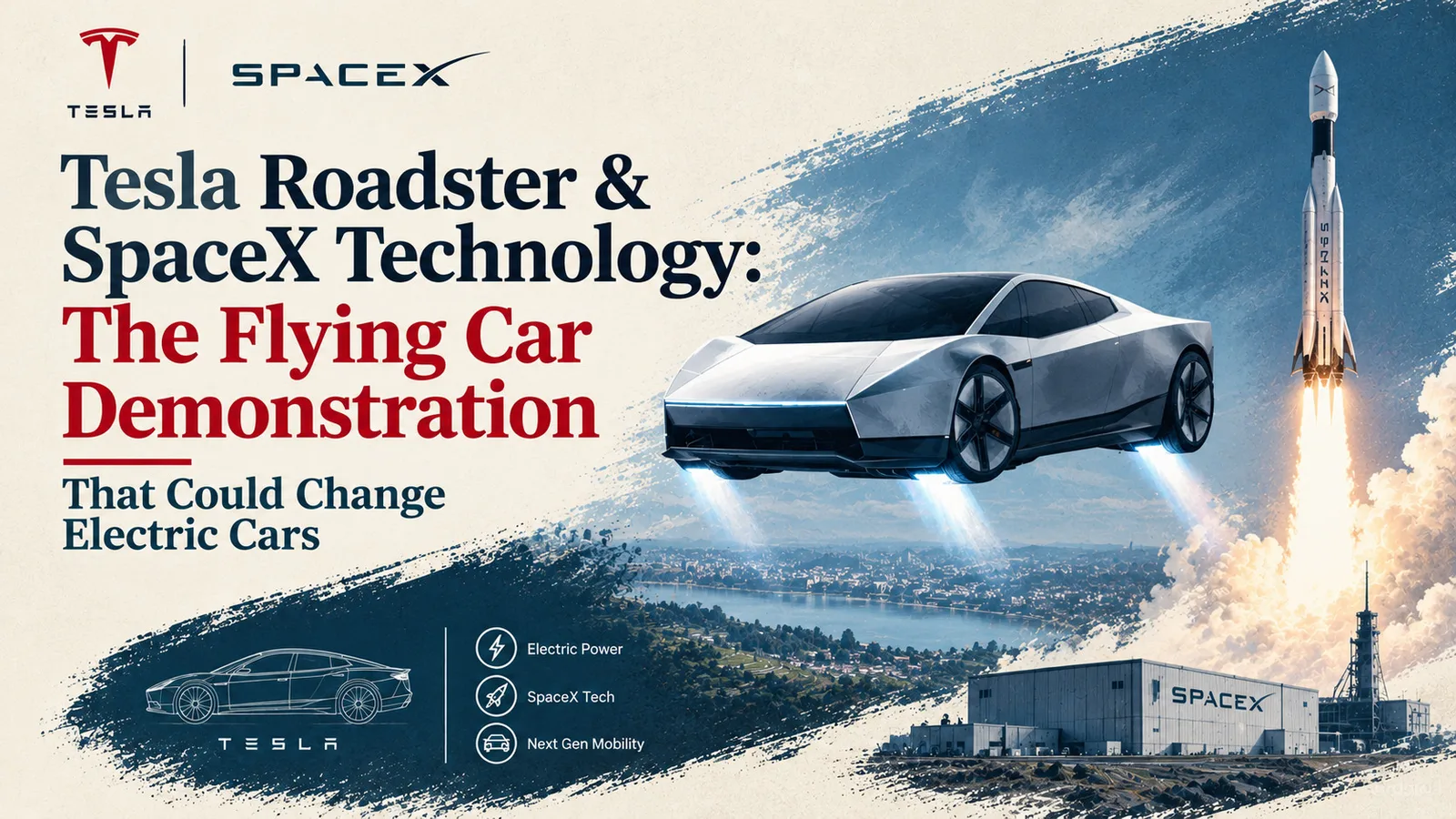
For years, Tesla's next-generation Roadster has been one of the most anticipated electric cars in the automotive industry. First announced in 2017, the electric sports car promised extraordinary acceleration, high performance and a design that would push the limits of conventional vehicles. After years of delays, Tesla has finally unveiled its redesigned Roadster, bringing an unexpected development into the spotlight: technology from SpaceX that allows a specially equipped version of the car to perform brief airborne manoeuvres.
The unveiling took place on October 15, 2026, at a SpaceX facility in Texas. The demonstration featured a Roadster prototype using cold-gas thrusters to lift off, rotate in the air and land again, creating one of Tesla's most unusual vehicle presentations to date.
The announcement also renewed interest in the relationship between Tesla and SpaceX, two companies led by Elon Musk that operate in very different industries but share an interest in pushing technological boundaries.
However, the new Roadster is not simply an ordinary electric car that can fly anywhere. Its rocket-inspired technology, special equipment requirements, production timeline and regulatory limitations raise important questions about how practical the concept will be outside a controlled demonstration.
Source: Reuters — Tesla's new Roadster turns in air with SpaceX thrusters.
What Happened at Tesla's Roadster Unveiling?
Tesla presented its redesigned second-generation Roadster during an event at SpaceX's testing facility in McGregor, Texas. The demonstration showed a vehicle moving along a curved ramp before briefly entering the air, rotating and returning to the ground.
The presentation was designed to demonstrate the capabilities of the vehicle's special thruster-equipped configuration. Rather than relying exclusively on conventional electric motors and tyres, this version incorporates technology inspired by aerospace propulsion systems.
The event attracted attention because it went beyond the usual electric-car launch. Tesla has long promoted acceleration, battery technology and vehicle performance, but the Roadster demonstration introduced a concept more commonly associated with experimental aerospace engineering.
According to TechCrunch's coverage of the unveiling, the demonstration also included the vehicle driving along an inverted ramp using a system designed to generate suction beneath the car.
Tesla has indicated that production is expected to begin in 2028. That means the unveiling represents an important development for the long-delayed vehicle, but it does not mean customers will immediately receive production-ready cars with every demonstrated capability.
How SpaceX Technology Could Help a Car Fly
One of the most unusual aspects of the new Roadster is its use of cold-gas thrusters.
Unlike conventional rocket engines that generate thrust through combustion, cold-gas propulsion releases pressurised gas through nozzles to produce a controlled force. Aerospace engineers use this principle in certain spacecraft systems for orientation and movement.
Tesla's special Roadster configuration adapts this general concept to a vehicle. According to the company's official Roadster website, the Rocket version features cold-gas thrusters positioned around the vehicle to support forward and upward acceleration as well as rotational movement.
These systems could help the car perform brief, controlled manoeuvres that ordinary road vehicles cannot achieve.
However, an airborne demonstration is not the same as a practical flying car. Sustained flight requires reliable control, sufficient energy or propellant, stable operation and appropriate safety systems. A vehicle that can briefly lift off and rotate does not automatically have the capabilities of an aircraft.
Tesla's demonstration therefore represents an unusual application of aerospace technology rather than proof that conventional road transport is about to be replaced by flying vehicles.
What Makes the New Tesla Roadster Different?
The redesigned Roadster combines electric-car engineering with several technologies intended to improve acceleration, handling and aerodynamic performance.
1. Rocket-inspired thrusters
The special Rocket configuration uses cold-gas thrusters to produce additional thrust. Tesla describes this version as capable of flight-like movement, including upward acceleration and rotation.
The company also lists a Thrust configuration with rear thrusters and a separate Rocket version with more extensive thruster placement. The Rocket configuration is listed as invite-only and is not approved for public-road use.
These distinctions matter because not every Roadster configuration has the same capabilities.
2. A specialised suction system
Tesla's website describes a multi-mode fan and ground-sealing system designed to pull air from beneath the vehicle. This generates additional downforce, helping the car maintain contact with a surface.
The company says the system can generate enough suction to hold the vehicle upside down, even when stationary.
If the system performs as described, it could offer an unusual approach to maintaining grip during specialised demonstrations and high-performance driving. Its practical value in ordinary road conditions, however, remains a separate question.
3. Advanced aerodynamics
Aerodynamic design is important for high-performance vehicles because it influences drag, stability and traction.
Tesla describes active aerodynamic components and adjustable driving modes intended to balance downforce and aerodynamic efficiency.
The challenge is that these objectives can conflict. Greater downforce can improve grip, but it may also increase drag. A successful design must balance these factors according to the vehicle's speed and intended use.
4. Extremely ambitious acceleration claims
Tesla has promoted acceleration figures of less than one second for the Roadster's more advanced configurations. The October demonstration also focused heavily on acceleration and the effects of additional thrust.
Such figures should be understood as manufacturer claims rather than independently established performance across ordinary driving conditions.
Acceleration depends on factors including traction, the measurement method, vehicle configuration and the conditions in which a test is conducted. Independent testing will be important in determining how the production vehicle performs.
Is Tesla Really Building a Flying Car?
The answer depends on what is meant by a flying car.
Tesla demonstrated a vehicle capable of briefly entering the air using specialised thrusters. The company also describes the Rocket configuration as capable of flight-like movement.
However, this does not make the Roadster equivalent to an aircraft designed for sustained flight, nor does it establish that owners will be able to operate it freely in public spaces.
A practical flying vehicle would need to address several challenges, including flight stability, emergency procedures, operating restrictions and the safety of people nearby.
The Roadster's Rocket configuration also has a significant limitation: Tesla explicitly states that it is not approved for public-road use.
For now, the most accurate description is an electric sports car with experimental, rocket-inspired capabilities in a specialised configuration. Whether those features become practical for customers will depend on engineering development, testing and regulatory requirements.
Why Tesla and SpaceX Are Working on Related Technology
Tesla focuses primarily on electric vehicles, energy storage and related technologies, while SpaceX develops launch vehicles, spacecraft and other aerospace systems.
Although their products serve different markets, both companies operate under Elon Musk's leadership and pursue engineering projects that attract attention for their ambitious goals.
The Roadster provides an example of how technology associated with one industry can influence another. Aerospace propulsion concepts are being explored alongside electric-vehicle engineering to create capabilities that would be unusual in a conventional sports car.
There are potential technical advantages to sharing knowledge across fields, but the practical value of any particular technology depends on its application.
SpaceX-inspired thrusters may help a specialised Roadster perform brief airborne manoeuvres, but they are not a replacement for the electric motors and battery system needed for normal driving.
The broader significance lies in the attempt to combine technologies from two industries that traditionally operate under different engineering constraints.
The Long Delay Behind Tesla's New Roadster
Tesla first introduced the second-generation Roadster in 2017, promising a high-performance electric sports car that would push the boundaries of acceleration and range.
The vehicle's development subsequently experienced repeated delays. The company continued to focus on other vehicles, manufacturing priorities and technology projects while the Roadster's expected arrival moved further into the future.
The October 2026 unveiling therefore represents more than a new product presentation. It brings renewed attention to a project that has remained in development for years.
Tesla now points to 2028 as the expected start of production. However, a demonstration vehicle and a production vehicle are not necessarily identical, and an announced timeline does not guarantee that deliveries will begin as scheduled.
Manufacturing, validation, component availability and regulatory requirements can all affect the final launch date.
For prospective customers, the key question is no longer simply what the Roadster might achieve in a demonstration. It is whether Tesla can deliver the promised capabilities in a reliable, usable and legally compliant vehicle.
How Much Will the Tesla Roadster Cost?
The final cost of the redesigned Roadster will be an important factor in determining its market appeal.
Tesla's current Roadster reservation page lists different configurations, including a standard road-oriented version, a Thrust configuration and the invite-only Rocket version.
The most specialised configuration is likely to appeal to a much narrower audience than a conventional electric sports car because of its unusual engineering and restrictions.
Potential buyers should distinguish between a reservation, a confirmed purchase agreement and an actual delivery commitment. A reservation does not guarantee a delivery date, and the final price or availability of a configuration can change before production.
Anyone considering the vehicle should rely on Tesla's official reservation terms for the latest pricing, payment conditions and delivery information rather than assuming that figures discussed during a demonstration represent final retail terms.
The Safety and Regulatory Challenges
The Roadster's unusual capabilities also raise questions about safety.
A vehicle designed for public roads must satisfy applicable requirements covering vehicle construction, braking, lighting, visibility and other safety-related features. A specialised configuration that uses thrusters to generate additional movement may face further regulatory questions.
The Rocket version's stated exclusion from public-road approval is particularly important. A successful demonstration at a controlled facility does not establish that the same vehicle is suitable for unrestricted operation in public spaces.
There are also questions about how such a system would behave during unexpected conditions, how its additional propulsion equipment would be maintained and how people nearby would be protected.
These issues require engineering validation and appropriate oversight. The more unusual a vehicle's capabilities become, the more important it is to establish clear operating limits and reliable safety procedures.
The Roadster's future will therefore depend on more than performance. It will also depend on whether the vehicle can meet the requirements associated with its intended use.
What the New Roadster Means for the Electric Vehicle Industry
The unveiling arrives at a time when electric-vehicle manufacturers are competing on more than battery range and charging speed.
Performance, software, manufacturing efficiency, autonomous-driving features and brand identity have become important areas of competition. Some companies are also exploring specialised technologies that could differentiate their products from conventional vehicles.
The Roadster's thruster demonstration illustrates how far a company may go to create a distinctive product. However, it remains unclear how many customers would value brief airborne capabilities enough to justify the added complexity.
For most electric-car buyers, everyday considerations are likely to remain more important: affordability, reliability, range, charging access, comfort and safety.
The Roadster may not change the mass-market electric-vehicle industry immediately, but it could influence how people think about the potential applications of electric propulsion and advanced vehicle engineering.
It also reinforces an important distinction between a technology demonstration and a commercially practical product.
Could This Technology Change the Future of Transportation?
The idea of combining road vehicles with flight capabilities has attracted engineers and inventors for decades. Advances in batteries, electric motors, control systems and lightweight materials have created new opportunities to explore alternative forms of transportation.
However, the challenges remain substantial. Vehicles that operate in the air must satisfy requirements that go beyond those of ordinary road cars, including flight stability, navigation, emergency management and the safe use of shared airspace.
The Roadster's demonstration is therefore best understood as a specialised experiment in vehicle performance rather than evidence that flying cars are about to become commonplace.
Its longer-term influence may be more modest but still interesting. The engineering work could encourage further exploration of propulsion control, aerodynamic systems and the integration of technologies from different industries.
Whether any of these developments eventually reaches more conventional vehicles remains to be seen.
Conclusion
Tesla's redesigned Roadster has returned to the spotlight with a demonstration that combines electric-car engineering and SpaceX-inspired propulsion technology. The brief airborne manoeuvre showcased a specialised configuration with capabilities far beyond those of a conventional sports car.
The unveiling also marks a new stage in the story of a vehicle that has faced years of delays since its initial announcement in 2017. Tesla expects production to begin in 2028, although the final specifications, delivery schedule and practical availability of its most advanced features will need to be confirmed as development progresses.
For now, the Roadster is an ambitious example of what can happen when engineers explore ideas across traditional industry boundaries. Its success will ultimately depend on whether the technology can move beyond an impressive demonstration and become a reliable, safe and usable product.
The event may not signal the arrival of everyday flying cars, but it has renewed the conversation about the future of electric vehicles and the possibilities of combining automotive engineering with aerospace technology.
Frequently Asked Questions
When did Tesla unveil the new Roadster?
Tesla unveiled the redesigned second-generation Roadster on October 15, 2026, at a SpaceX facility in Texas.
Can the Tesla Roadster really fly?
Tesla's specialised Rocket configuration uses cold-gas thrusters designed to support upward movement and rotation. The company demonstrated a brief airborne manoeuvre, but this is not the same as sustained aircraft-like flight.
When will the new Tesla Roadster enter production?
Tesla has indicated that production is expected to begin in 2028. The timeline remains subject to development and manufacturing progress.
What is the SpaceX technology used in the Roadster?
The specialised configuration uses cold-gas thrusters inspired by aerospace propulsion systems. Tesla also describes a suction-based system intended to generate additional downforce.
Is the flying Roadster legal to drive on public roads?
Tesla states that its Rocket configuration is not approved for public-road use. Approval for any other configuration depends on its specifications and applicable regulations.
How fast is the new Tesla Roadster?
Tesla has promoted acceleration of less than one second from 0 to 60 mph for advanced configurations. These are manufacturer claims, and independent testing will be needed to establish real-world production performance.
Will the new Roadster be available to ordinary buyers?
Tesla lists multiple configurations, but availability and delivery conditions may differ. The Rocket version is listed as invite-only, and its final availability and production details should be confirmed directly with Tesla.
Sources and Further Reading
Reuters: Tesla's new Roadster turns in air with SpaceX thrusters
Associated Press: Tesla unveils its second-generation Roadster with airborne thrusters
TechCrunch: Tesla reveals SpaceX-powered Roadster that flies and falls with style
The Guardian: Elon Musk reveals 'world's first flying car' at SpaceX event